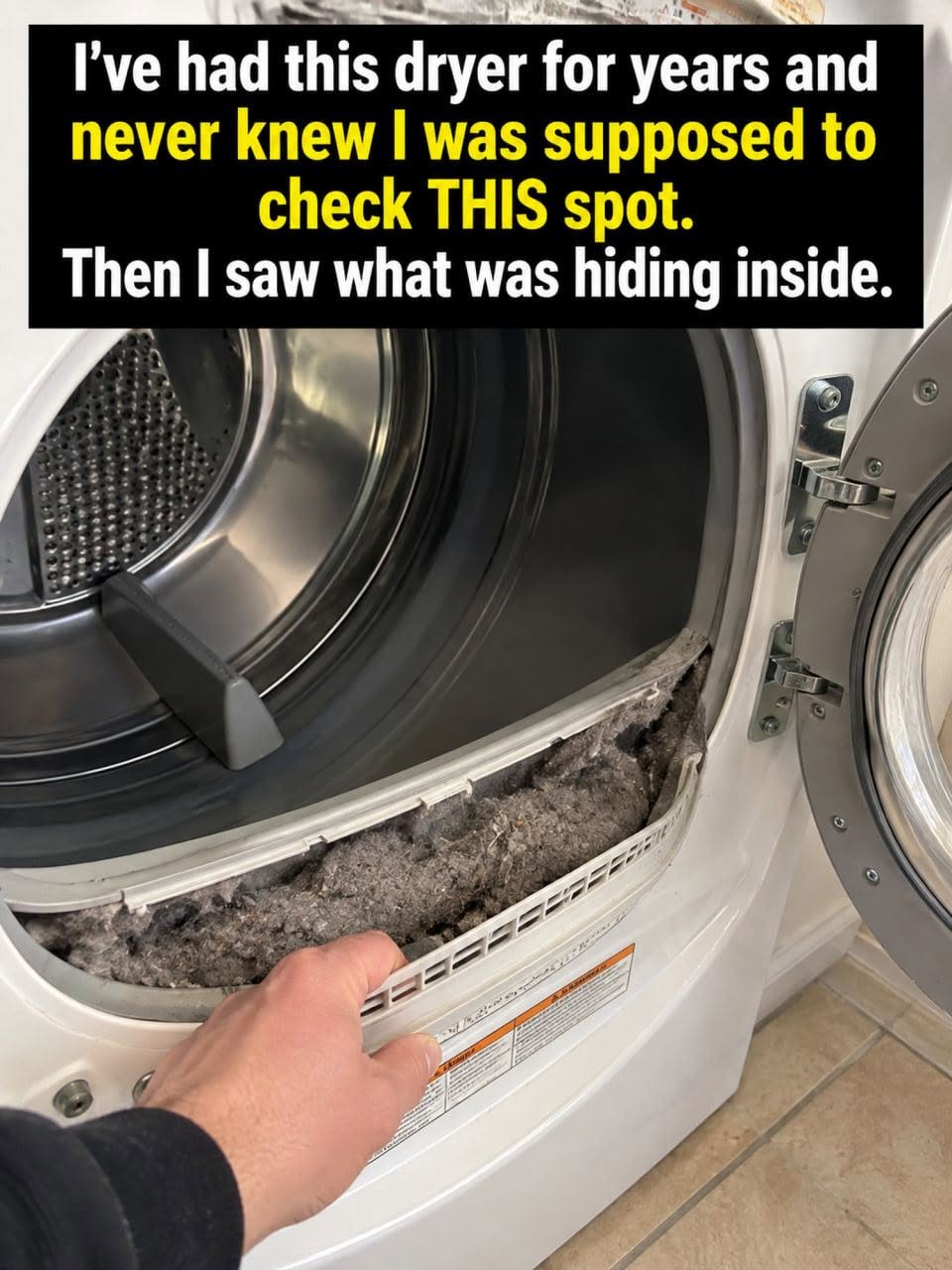
You probably clean your dryer’s lint screen after every load, or at least you know you’re supposed to. But when you look beyond that removable screen, you may discover something surprising: lint can accumulate in other accessible areas of a dryer and its exhaust system too.
That fuzzy material may look harmless, but dryer maintenance isn’t simply about keeping an appliance looking clean. Excess lint can restrict airflow, make drying less efficient, and contribute to a potential fire hazard.
The important detail is that dryers are not all designed the same way. The removable panel, lint-filter housing, condenser area, and other components shown on one machine may not exist—or may not be user-serviceable—on another.
So before opening panels or attempting deeper cleaning, check your dryer’s manual and follow the manufacturer’s maintenance instructions.
Where Does All That Lint Come From?
Every time clothing, towels, sheets, and other fabrics tumble inside a dryer, tiny fibers can separate from the material.
The dryer’s lint filter is designed to capture much of this material before air moves farther through the system.
But a lint screen isn’t necessarily capable of capturing every tiny fiber. Some material can pass through, while other lint may collect around accessible areas near the filter or elsewhere in the exhaust path over time.
This is one reason routine maintenance involves more than simply waiting until the dryer stops working properly.
The Lint Screen Is Still Your First Line of Defense
The easiest and most frequent maintenance step is also one of the most important: clean the lint filter according to the manufacturer’s directions.
For many conventional dryers, this means removing accumulated lint before or after each load.
A heavily covered filter can reduce airflow through the machine.
Cleaning it takes only a few seconds, yet it’s one of those household habits that is easy to postpone when you’re rushing through several loads of laundry.
Look Around the Lint Filter Opening
When the lint screen is removed, you may notice additional lint around the accessible edges of its housing.
Don’t blindly push tools or your hand deep inside the machine.
Instead, follow the maintenance procedure described in your owner’s manual. Some manufacturers provide specific instructions for vacuuming or cleaning accessible portions of the lint-filter area.
If your manual permits it, carefully removing accumulated lint from accessible areas can help prevent it from building up unnecessarily.
What Is That Lower Panel on Some Dryers?
This is where things become model-specific.
Some dryers have a lower access area associated with components that require periodic maintenance. Certain ventless or heat-pump dryers, for example, may have filters or heat-exchanger areas that are maintained differently from those in traditional vented dryers.
Other machines may have panels that aren’t intended for routine homeowner access at all.
Never assume that a panel should be removed simply because you saw someone doing it online.
The correct maintenance procedure depends on the exact dryer.
Why Restricted Airflow Matters
A dryer needs airflow to do its job effectively.
As wet laundry tumbles, moisture has to be removed. In a conventional vented dryer, warm moisture-laden air eventually travels through an exhaust system to the outdoors.
If airflow becomes restricted, drying performance can suffer.
You may notice loads taking longer than expected, clothing remaining damp after a normal cycle, or the machine operating for longer periods.
Those symptoms don’t automatically prove that lint is the cause, but they are reasons to investigate rather than simply running another cycle again and again.
And the lint you can see near the dryer is only part of the maintenance story.