
Frequently Asked Questions About SSSS
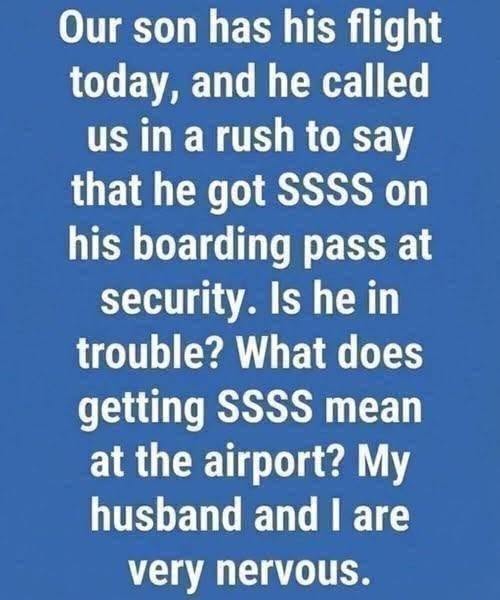
What exactly does SSSS mean on a boarding pass?
SSSS stands for Secondary Security Screening Selection. It indicates that the passenger has been selected for additional aviation-security screening.
Should I be worried if I see SSSS?
You should prepare for additional screening and allow extra time, but the code by itself should not be treated as proof that you have done something wrong.
Can I still fly with SSSS?
SSSS does not itself mean you are prohibited from flying. It means additional screening is required before you are cleared to proceed.
Does SSSS mean I am on the no-fly list?
No. Additional security screening and being prohibited from flying are not the same thing. The boarding-pass code alone does not establish that you are on a no-fly list.
Why did I get SSSS?
A passenger generally cannot determine the exact reason from the boarding pass. Security-related criteria and random selection can play roles, and detailed selection methods are not publicly disclosed.
Can SSSS happen randomly?
Yes. Randomized screening is part of aviation-security systems, so a one-time selection does not necessarily indicate a recurring issue.
Will I get SSSS every time after receiving it once?
Not necessarily. Some travelers receive additional screening on one journey and not on subsequent trips.
What if I receive SSSS repeatedly?
If you repeatedly experience additional security or travel-screening difficulties, review your reservation information for accuracy and consider whether the DHS Traveler Redress Inquiry Program is appropriate for your situation.
Can TSA PreCheck passengers receive SSSS?
Participation in expedited screening does not guarantee exemption from additional security measures. Passengers should follow the instructions applicable to each individual trip.
Can Global Entry members get additional screening?
Yes. Trusted-traveler membership does not guarantee that a passenger will never receive additional aviation-security screening.
How long does SSSS screening take?
There is no universal duration. It depends on the airport, passenger volume, staffing, belongings being inspected, and procedures required at that time.
Should I arrive earlier if SSSS is on my boarding pass?
Yes. Follow the airline’s normal recommended arrival time and consider allowing additional time because secondary screening can make the security process longer.
Will my bags be searched?
Carry-on belongings may receive additional inspection. The exact procedures vary according to security requirements and circumstances.
Will I receive a pat-down?
Additional passenger screening may include a pat-down or other approved screening procedures. Follow instructions and communicate any relevant medical, disability, or privacy concerns to security personnel.
Will officers swab my belongings?
Explosive trace detection may be used during secondary screening, which can involve swabbing bags, electronics, or other surfaces.
Do I need to unlock my carry-on?
If security personnel need to inspect a carry-on bag, passengers should follow their instructions and provide access as required for screening.
Can I ask why I was selected?
You can ask questions about the process, but personnel may not be able to provide the specific internal reason for your selection.
Can an airline remove SSSS?
Travelers should not assume that a check-in or gate agent can simply cancel a required security designation. The practical approach is to complete the required screening.
Is SSSS used everywhere in the world?
The SSSS designation is associated with U.S. aviation-security procedures. Other countries maintain their own security systems and may use different processes.
Can SSSS appear on an international flight to the United States?
Additional security procedures can apply to travel involving the United States, including certain international departures. Travelers should follow the procedures required at the departure airport.
Can SSSS prevent online check-in?
Some passengers selected for additional processing may need to complete check-in or document verification at the airport. However, online check-in can fail for many unrelated reasons, so failure to obtain a mobile boarding pass does not automatically mean SSSS.
Is SSSS connected to my nationality?
The boarding pass does not reveal why a particular passenger was selected. It is therefore inappropriate to infer a specific cause solely from the presence of the code.
Should I change my travel plans if I see SSSS?
Usually, the practical response is simply to allow extra time and complete the required screening rather than canceling an otherwise valid journey solely because SSSS appears.
Can I avoid SSSS by changing my ticket?
Travelers should not attempt to manipulate reservations to circumvent security screening. If you have recurring problems, official redress channels are more appropriate.
What is DHS TRIP?
DHS TRIP is the U.S. Department of Homeland Security’s Traveler Redress Inquiry Program. It provides a process for travelers seeking redress regarding certain recurring difficulties with travel screening or border procedures.
Does filing for redress guarantee SSSS will disappear?
No. A redress inquiry does not guarantee exemption from future security screening. Security authorities retain the ability to conduct appropriate screening.
Is a Redress Control Number the same as a Known Traveler Number?
No. They serve different purposes. A Known Traveler Number relates to eligible trusted-traveler or expedited-screening programs, while a Redress Control Number relates to the traveler redress process.
What Is the Best Way to Handle SSSS?
The most effective strategy is preparation.
Arrive early, keep your identification and travel documents accessible, organize your carry-on, follow instructions, and expect the process to take longer than your normal airport routine.
If the designation occurs only once, there may be no reason to do anything afterward.
If it repeatedly appears across trips, check that your identifying information is accurate and consider the appropriate official traveler-redress process.
Final Thoughts
The four letters SSSS can look intimidating when they suddenly appear on a boarding pass, particularly for a traveler who has never encountered them before. But their basic meaning is straightforward: Secondary Security Screening Selection.
The passenger should expect additional security screening before being cleared to continue the journey. That can involve closer inspection of carry-on belongings, additional passenger screening, explosive trace detection, identity verification, or other procedures appropriate to the situation.
What SSSS does not tell you is equally important. The code alone does not prove that you are suspected of a crime, does not establish that you are on a no-fly list, and does not necessarily mean that future trips will involve the same process.
There is also no reliable public formula that lets passengers determine exactly why they were selected. While particular travel patterns are frequently discussed online, security systems include criteria that are not publicly disclosed as well as unpredictable screening elements.
For most travelers, therefore, the best response is simple: do not panic, arrive with additional time, keep your documents and belongings organized, cooperate with the required screening, and continue with your journey once cleared.
If SSSS becomes a repeated feature of your travel rather than an isolated occurrence, official traveler-redress procedures may provide an appropriate next step.
Ultimately, SSSS is best understood not as an accusation hidden on your boarding pass, but as an instruction within the aviation-security system that additional screening is required for that particular journey.