ADVERTISEMENT
Habitat preferences and reproductive behaviors of the species responsible for such eye-catching egg masses are closely tied to seasonal wetlands, vernal pools, and shallow ponds that provide temporary or semi-permanent water bodies free from many fish predators.
ADVERTISEMENT
Southern leopard frogs and their relatives typically breed in early spring when temperatures rise and rains fill breeding sites, with males calling loudly to attract females.
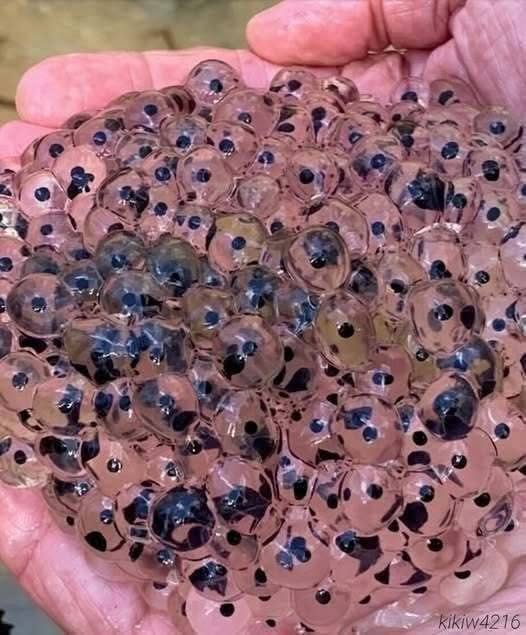
During amplexus—the mating embrace—the female releases hundreds to several thousand eggs while the male fertilizes them externally, resulting in the communal globular masses seen in the photo.
These clutches are often deposited in shallow water attached to vegetation or floating freely, where the transparent jelly blends somewhat with the surroundings yet remains conspicuous enough for the “eyeball” effect to emerge under certain lighting.
Similar masses from related species, such as wood frogs or pickerel frogs, share the black-on-top embryonic patterning, though subtle differences in jelly thickness and embryo coloration help herpetologists distinguish them in the field.
ADVERTISEMENT
The pinkish tint in this particular image may also stem from the handler gently lifting the mass out of water for photography, causing light refraction through the moist jelly and skin contact.
In their natural setting, these clusters contribute significantly to the food web, supporting diverse predators while ensuring the next generation of frogs that help control insect populations in ecosystems worldwide.
The life cycle unfolding inside each of these mesmerizing eyeball eggs follows a precisely orchestrated sequence of embryonic development that transforms a simple fertilized cell into a free-swimming tadpole within days to weeks, depending on water temperature and species.
Fertilization occurs externally as sperm meets eggs in the water, after which the embryo begins rapid cell division within the protective jelly. Early stages focus on forming the neural tube and basic body axis, with the eyes and brain structures developing prominently—accounting for the large, dark central spots that give the “staring” illusion.
Oxygen diffuses inward through the permeable gelatinous layers while metabolic wastes diffuse outward, sustaining the embryo without direct parental care. As the tadpole forms, it develops a tail, gills for underwater breathing, and a mouth for future feeding; the yolk initially provides all nutrition until hatching.
Environmental cues like temperature, oxygen levels, and even vibrations from nearby predators can influence hatching timing in some related species, allowing embryos to escape danger prematurely if needed.
Once hatched, the tiny tadpoles wriggle free from the dissolving jelly and begin their aquatic phase, grazing on algae and detritus before undergoing the dramatic metamorphosis into terrestrial frogs, complete with legs, lungs, and the ability to leap onto land.
This transformation, often completing in weeks to months, highlights the adaptability of amphibians bridging aquatic and terrestrial worlds.
Beyond their biological intrigue, these eyeball egg clusters hold broader ecological and cultural significance as indicators of healthy wetland ecosystems and sources of wonder that bridge science with public fascination.
Amphibians like leopard frogs serve as sentinel species whose reproductive success reflects water quality, habitat connectivity, and climate stability—declines in egg mass numbers can signal pollution, habitat loss, or disease outbreaks such as chytrid fungus.
For educators and citizen scientists, discovering such masses during spring “egg hunts” in vernal pools provides hands-on opportunities to learn about biodiversity, life cycles, and conservation without harming the clutch if handled gently and returned promptly.
Online, images like the one described frequently go viral, sparking discussions that range from scientific identification to playful memes about “forbidden jelly” or “nature’s candy.”
This accessibility democratizes natural history, encouraging people to appreciate the hidden complexities in everyday ponds and marshes. Conservation efforts increasingly involve monitoring amphibian breeding sites to protect these fragile early stages from drainage, invasive species, and chemical runoff, ensuring future generations can witness the same surreal beauty.
In conclusion, the surreal beauty of these eyeball eggs reminds us of nature’s endless capacity for surprise and ingenuity, turning a simple reproductive strategy into a visual phenomenon that captivates hearts and minds across the globe.
From the protective jelly architecture to the staring embryonic “pupils,” every detail underscores the delicate balance of life in ephemeral wetlands. Whether encountered in a quiet pond or captured in a striking photograph held in a human hand, such clusters invite deeper curiosity about the interconnected web of life.
Protecting the habitats that support these egg masses ultimately safeguards not only frogs but entire ecosystems dependent on their ecological roles as both predators and prey.
Next time you spot a glistening jelly blob in shallow water, pause to appreciate the thousands of tiny lives developing inside—each one a miniature marvel with the potential to leap into adulthood and continue the ancient cycle of amphibian metamorphosis that has persisted for millions of years.