For older adults, financial stability can be especially important because employment income may decrease or disappear after retirement. At the same time, housing, healthcare, food, transportation, and everyday expenses continue.
Having a realistic financial plan can therefore provide something extremely valuable: peace of mind.
Financial security does not necessarily mean being wealthy.
It can mean knowing where your money comes from, understanding your regular expenses, avoiding unnecessary debt, and having a plan for unexpected costs.
Planning ahead can help older adults maintain control over their choices.
For example, someone who
understands their monthly budget may be better prepared to decide whether they can afford to travel, help family members financially, move to a different home, or pay for services that make daily life easier.
It is also important to avoid assuming that family members will automatically be able to provide financial support.
Children may have their own mortgages, careers, children, medical expenses, or financial responsibilities. A strong relationship with family should ideally be based on affection and mutual support rather than financial dependence alone.
This does not mean older adults
should refuse help.
Accepting reasonable assistance from loved ones can be completely healthy. The important thing is maintaining as much financial independence as circumstances allow.
A useful principle is:
Plan your finances so that your relationships can be based on love rather than obligation.
- Independence Is More Valuable Than Many People Realize
One of the greatest fears associated with aging is losing independence.
Being able to prepare your own meals, manage your appointments, move around safely, make decisions, handle personal finances, and participate in everyday activities can provide a powerful
sense of dignity.
Independence does not mean doing absolutely everything alone.
That distinction is important.
A person can remain independent while receiving help with certain tasks. For example, someone might use transportation assistance, hire help with housework, or ask a family member to accompany them to a medical appointment while still making their own decisions.
True independence is often about having choices.
Can you decide how you want to spend your day?
Can you choose where you want to live?
Can you manage your personal affairs?
Can you communicate your
preferences?
Can you participate in activities that matter to you?
These abilities contribute greatly to a person’s sense of control.
Maintaining physical strength can help. So can keeping the mind active and learning how to use modern technology.
Technology can sometimes feel intimidating, especially when devices and online services change quickly. But learning to use smartphones, video calls, online banking, transportation apps, and other tools can help older adults stay connected and manage everyday tasks.
Home safety is another important consideration.
Simple modifications such as better lighting, removing trip hazards,
installing handrails where appropriate, or organizing frequently used items within easy reach can make daily life safer.
The goal is not to pretend that aging does not bring limitations.
The goal is to adapt intelligently to changing abilities.
- Having a Purpose Can Give Life Meaning
Perhaps the most overlooked part of healthy aging is purpose.
When people retire, they sometimes lose more than a paycheck. They may also lose a routine, professional identity, social interaction, and a feeling that other people depend on them.
That can create an unexpected emotional
challenge.
For decades, a person’s schedule may have been organized around work and family responsibilities. Suddenly, there may be large amounts of free time.
Free time sounds wonderful in theory.
But too much unstructured time can sometimes lead to boredom, loneliness, or a feeling that life has become repetitive.
This is why having a purpose can be so important.
Purpose does not have to mean starting a business or accomplishing something extraordinary.
It can be as simple as caring for a garden, learning an instrument, reading, volunteering, exercising, cooking for
family, mentoring younger people, creating art, caring for a pet, or participating in a local community.
Some people discover purpose through helping others.
Others find it through creativity, spirituality, education, travel, or personal projects.
The activity itself is less important than the feeling that your time has meaning.
A morning routine can help.
Getting up at a consistent time, getting dressed, having breakfast, going outside, exercising, and dedicating time to a meaningful activity can create structure.
Purpose gives the day somewhere to go.
What About Friends, Children, and a Spouse?
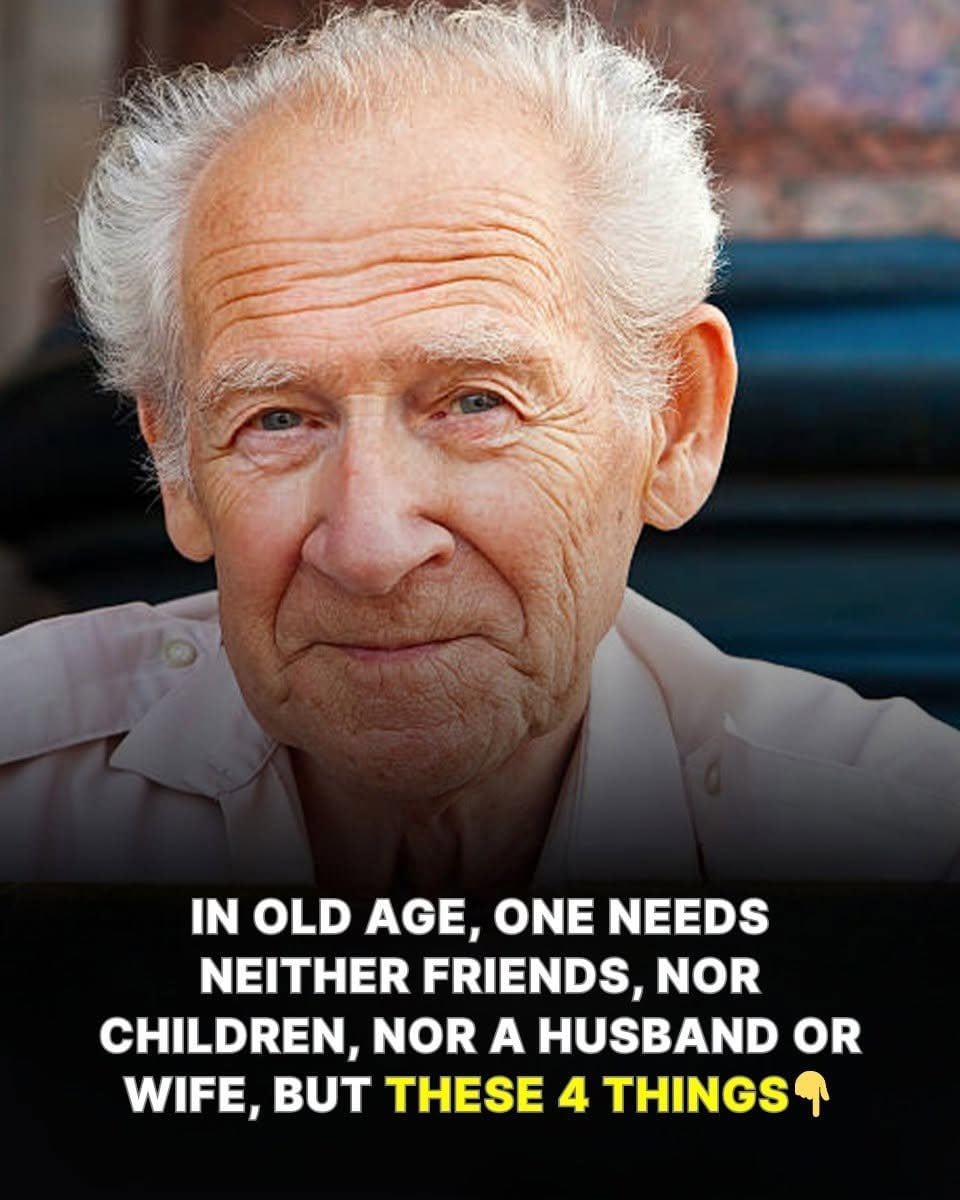
This is where the message in the image needs some important context.
The idea that older adults need neither friends, children, nor a husband or wife should not be taken literally.
Human connection remains important at every age.
Research on aging consistently emphasizes the importance of social relationships and social participation. Isolation and loneliness can negatively affect well-being, while meaningful relationships can provide emotional support, companionship, and a sense of belonging.
However, there is an important distinction between needing relationships and depending entirely on other people for your happiness or
survival.
A person can love their children without expecting their children to organize their entire life.
A person can deeply appreciate a spouse without losing their individual identity.
A person can have close friends without making their entire emotional well-being dependent on one person.
Healthy aging can therefore involve both connection and independence.
You can need people emotionally while still developing the ability to take care of yourself.
You can enjoy family without expecting family to solve every problem.
You can appreciate companionship while also learning to enjoy your ow
company.
Learning to Enjoy Your Own Company
One of the most valuable skills in later adulthood may be learning how to spend time alone without feeling lonely.
There is a major difference between solitude and loneliness.
Solitude is chosen. Loneliness is painful disconnection.
Someone might spend an afternoon reading alone and feel completely satisfied. Another person might sit in a crowded room and still feel isolated.
Developing comfortable solitude can make life more resilient.
It means you can enjoy a quiet morning, take a walk, read a book, cook a
a deeper understanding of themselves. They may become less concerned with other people’s opinions and more interested in what genuinely makes them happy.
Aging successfully often requires adaptation.
Maybe you cannot exercise in exactly the same way you did at 30, but you can find activities appropriate for your current abilities.
Maybe your career has ended, but you can discover another meaningful role.
Maybe your children live far away, but technology can make regular communication easier.
Maybe your social circle has changed, but new friendships can still be developed.
Maybe
your financial situation is different, but careful planning can help you make thoughtful decisions.
The goal is not to recreate youth.
The goal is to make the most of the life you have now.
Small Habits Can Create a Stronger Future
Healthy aging does not usually come from one dramatic decision.
It is built through small actions repeated over time.
Taking a walk today.
Calling a friend.
Preparing a nutritious meal.
Checking your finances.
Learning something new.
Going to bed at a reasonable time.
Visiting your doctor when necessary.
Cleaning
a potentially dangerous area of the home.
Writing down your goals.
Starting a hobby.
Helping someone else.
These actions may seem ordinary, but together they can create a lifestyle that supports independence and well-being.
The best time to prepare for later life is not necessarily when old age arrives.
It is much earlier.
Every healthy habit developed today can potentially make tomorrow easier.
The Four Things Worth Protecting as You Age
If we transform the message in the image into a more realistic lesson, the four important areas could be
summarized as:
- Your Health
Protect your mobility, strength, nutrition, sleep, and overall well-being.
- Your Financial Security
Understand your income, expenses, savings, and future needs so you can make decisions with greater confidence.
- Your Independence
Maintain the skills, environment, and resources that allow you to make choices and participate in daily life.
- Your Purpose
Have reasons to get up each morning—whether that comes from family, hobbies, volunteering, learning, creativity, work, spirituality, or helping others.
And there is a fifth element that should not be forgotten:
Meaningful Relationships
Friends, family members, neighbors,
community groups, and other social connections can add companionship, emotional support, and meaning to life.
Final Thoughts
Growing older does not mean that a person should stop needing other people.
Nor does it mean that family relationships become unimportant.
Instead, healthy aging can be viewed as a balance between connection and independence.
Build a body you can rely on as much as possible.
Create financial habits that reduce unnecessary stress.
Protect your ability to make your own decisions.
Find activities that give your days meaning.
And maintain relationships that bring
genuine companionship and support.
The strongest position in later life is not having nobody to depend on.
It is having people you love, while also developing the strength to stand on your own when necessary.
Old age can bring challenges, but it can also bring freedom, wisdom, perspective, and time.
The question is not simply, “Who will be there for me when I get old?”
A better question may be:
“What kind of person, lifestyle, relationships, and daily routine can I build today so that I can continue to live
with dignity, purpose, and connection tomorrow?”
That is a question worth answering at any age.