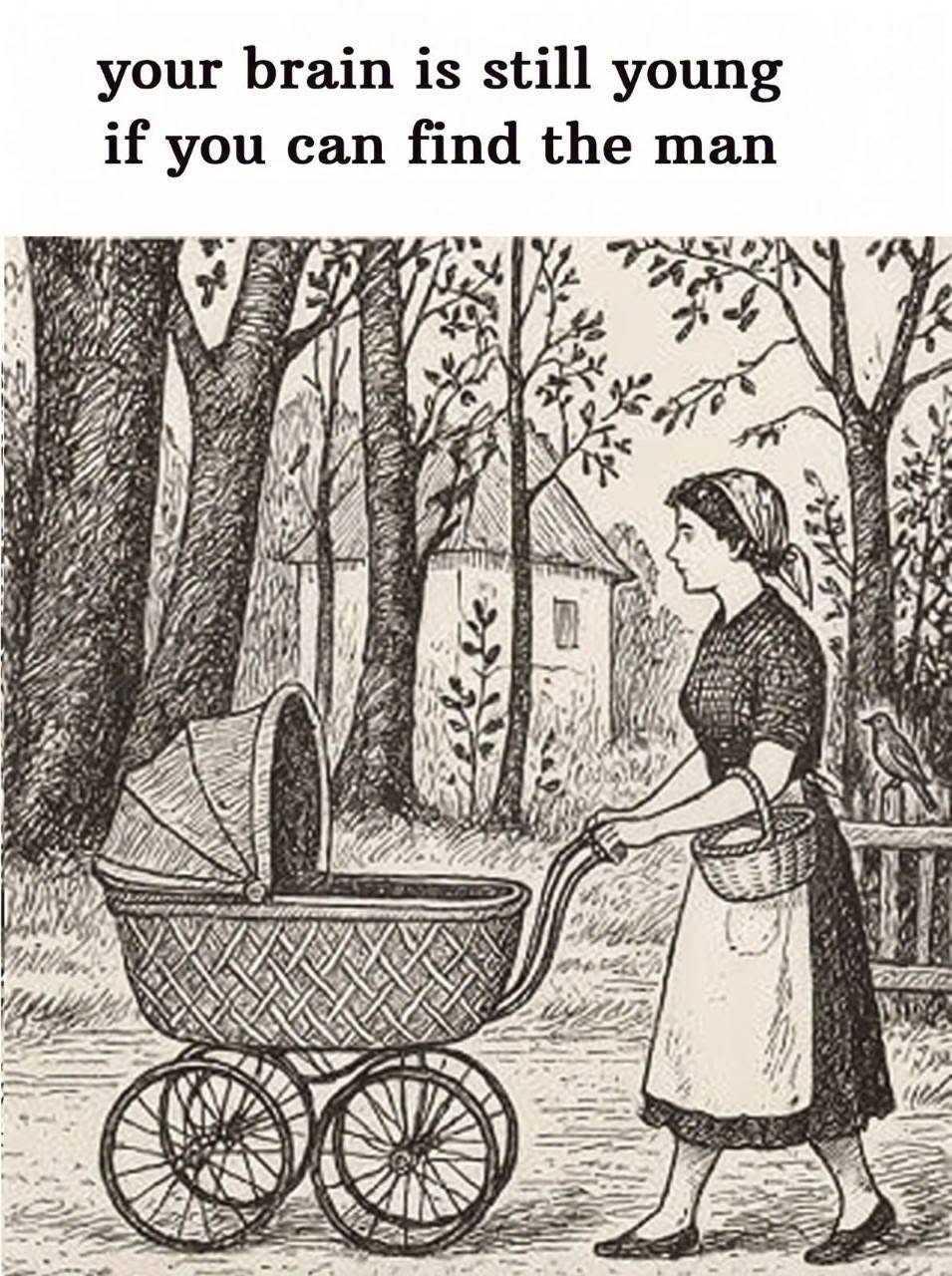
One second:
Nothing.
The next:
THERE HE IS.
This sudden change happens because perception isn’t simply about detecting lines.
Your brain has to assign meaning to those lines.
Before you recognize the hidden figure, your brain may group the shapes into one interpretation.
Afterward, it has a new framework.
Now the same visual information supports another interpretation.
That’s why the discovery can feel so dramatic.
Once You See Him, You Can’t Unsee Him
This is one of the strangest things about hidden-image puzzles.
Once your brain has learned the hidden pattern, it becomes much easier to find it again.
You have essentially created a new interpretation of the image.
The visual information hasn’t changed.
Your knowledge has.
And this is a beautiful example of how top-down processing can influence perception.
Your previous experience and expectations can affect what you perceive.
Knowing what you’re looking for gives your brain a powerful advantage.
Is This a Test of Intelligence?
Not really.
And please don’t panic if everyone around you sees the hidden man before you do!!
Optical illusions aren’t reliable intelligence tests.
How quickly someone notices a hidden figure can be influenced by many factors, including attention, familiarity with visual puzzles, viewing conditions, expectations, and simply how the image is constructed.
Someone who spots the man immediately isn’t necessarily “smarter.”
Someone who takes longer isn’t necessarily less perceptive.
In fact, these puzzles demonstrate something much more interesting:
Human vision is flexible.
Why Some People Spot Hidden Images Faster
There isn’t one simple explanation for why one person sees a concealed figure quickly while another struggles.
But several factors can matter.
Attention
If you’re actively searching for a person, you’re more likely to notice shapes that resemble a human body.
If you think you’re simply looking at a landscape, your brain may organize the same shapes differently.
Experience
People who regularly solve visual puzzles may know to look for unusual outlines, reversed figures, negative space, and overlapping shapes.
They’ve learned the tricks.
Expectations
If someone tells you, “There’s a man hidden near the tree,” you’re already approaching the picture differently.
Your brain has been given a search strategy.
Viewing Distance
Some illusions become easier to recognize when viewed from farther away.
Others work better up close.
That’s because changing distance changes the visual information reaching your eyes and how the overall pattern is organized.
The Illusion Is Playing a Little Trick on Your Brain
The artist isn’t necessarily hiding the man by making him invisible.
Instead, the figure is hidden by ambiguity.
The lines belong to more than one possible interpretation.
That’s much cleverer.
Imagine drawing a line.
It could be:
a branch,
a man’s arm,
a shadow,
a crack,
or part of a building.
The artist’s job is to arrange enough ambiguous elements that your brain chooses the wrong interpretation first.
Then, once you’ve discovered the alternative, the puzzle suddenly makes sense.
Why Humans Are So Good at Seeing Faces
There’s another fascinating feature of hidden-image puzzles: faces are incredibly attention-grabbing.
Humans are remarkably sensitive to facial patterns.
We’re constantly scanning other people’s faces for information about emotion, identity, attention, and intention.
That’s why you can sometimes find a face hidden in clouds, wood grain, wallpaper, or random textures.
This tendency is known as pareidolia.
What Is Pareidolia?
Pareidolia is the tendency to perceive a familiar meaningful pattern—especially a face or object—in an ambiguous or random visual stimulus.
It’s why a cloud can look like a rabbit.
It’s why a knot in a piece of wood can look like an eye.
And it’s why your brain might suddenly discover a face in a completely ordinary pattern.
In a carefully designed optical illusion, however, the hidden image isn’t random.
The artist has intentionally arranged the visual elements to encourage that interpretation.
The Difference Between an Optical Illusion and Pareidolia
These terms are related, but they aren’t identical.
An optical illusion is a visual experience in which perception differs from what might be expected from the physical stimulus.
A hidden-image puzzle deliberately creates ambiguity so that one interpretation may initially dominate another.
Pareidolia, on the other hand, describes our tendency to perceive meaningful objects or patterns—often faces—in ambiguous stimuli.
So if you see a face in your toast?
That’s pareidolia.
If an artist deliberately creates an image where a landscape contains a hidden human figure?
That’s a concealed-image illusion.
Your brain is doing something similar in both cases: finding meaning in visual information.
Why Optical Illusions Are So Addictive
Let’s be honest.
These puzzles are ridiculously hard to ignore.
Someone says:
“There’s a man hidden in this picture.”
And suddenly you have to find him.
For Complete Cooking STEPS Please Head On Over To Next Page Or Open button (>) and don’t forget to SHARE with your Facebook friends