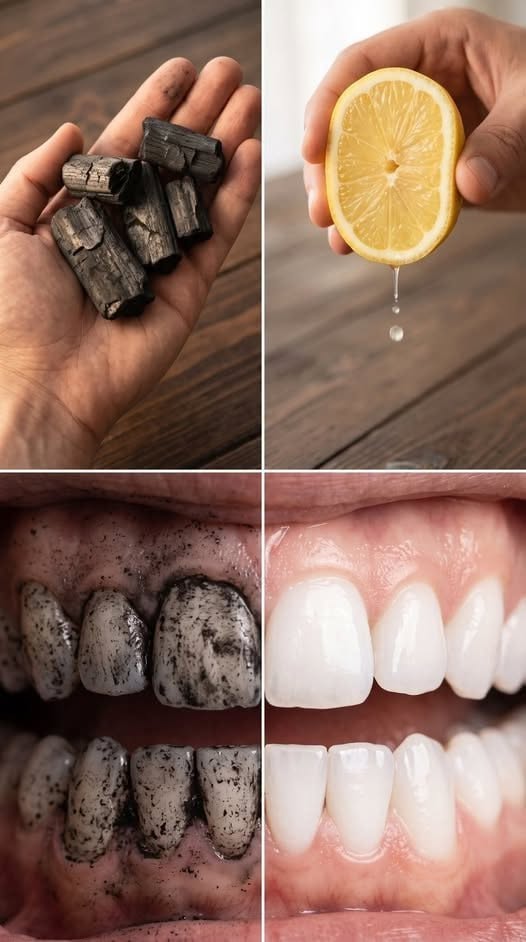
Nature provides an abundance of ingredients that can be used in creative ways for personal care, and lemon juice combined with activated charcoal is one example. However, while both ingredients have properties that make them popular in DIY beauty routines, some commonly claimed benefits are not well established, and certain uses may carry risks. Here is a safer look at how these ingredients are sometimes used and what to consider before trying them.
1. Teeth Whitening: A Natural Way to Brighten Your Smile
Activated charcoal is often marketed as a way to remove surface stains from teeth, while lemon juice contains citric acid that can affect discoloration. However, there is limited evidence that activated charcoal provides meaningful teeth-whitening benefits, and lemon juice is acidic enough to weaken or erode tooth enamel with repeated exposure.
For this reason, applying a mixture of activated charcoal and lemon juice directly to your teeth is not recommended as a routine whitening method.
How to Approach Teeth Whitening More Safely
Instead of brushing with lemon juice or abrasive charcoal mixtures, consider using a fluoride toothpaste and, if you want stronger whitening, discuss professionally recommended whitening products with a dentist.
Professional guidance can also help determine whether tooth discoloration is caused by surface stains or by changes within the tooth itself. The latter may not respond to ordinary whitening products.
2. Detoxifying Face Mask: Clear Skin Naturally
Activated charcoal is commonly included in cosmetic masks because it can adsorb certain substances on the skin’s surface. However, claims that it “pulls out toxins” or detoxifies the body through the skin are not well supported by clinical evidence.
Lemon juice contains citric acid and may temporarily alter the skin’s surface, but applying fresh lemon juice directly to the face can cause irritation, dryness, and increased sensitivity to sunlight. In some people, exposure to sunlight after contact with citrus compounds can result in a skin reaction.
For these reasons, a homemade face mask containing fresh lemon juice is not an ideal choice for sensitive or easily irritated skin.
How to Approach a Charcoal Face Mask More Safely
If you want to try a cosmetic charcoal mask, choose a product specifically formulated and tested for facial use rather than applying concentrated lemon juice to the skin.
Always follow the product directions and perform a patch test when trying a new skincare product. Avoid applying masks to broken, irritated, or sunburned skin, and stop using a product if burning, swelling, or significant redness occurs.
3. Exfoliating Scrub: Gentle Yet Effective
Adding sugar to a charcoal-and-lemon mixture creates a physical scrub that may temporarily make skin feel smoother. However, sugar particles can be abrasive, and combining physical scrubbing with acidic lemon juice may increase irritation.
Frequent or vigorous exfoliation can damage the skin barrier, particularly in people with sensitive skin, acne, eczema, or other inflammatory skin conditions.
How to Exfoliate More Gently
For rough or dull-looking skin, a gentle cleanser and a properly formulated exfoliating product may be a better option than a homemade lemon-and-sugar scrub. If you use a physical exfoliant, massage it very lightly and avoid using it on irritated or damaged skin.
After exfoliation, apply a gentle moisturizer to help maintain the skin barrier. Daily broad-spectrum sunscreen is also important because sun exposure can contribute to uneven skin tone and premature skin aging.
There is another popular DIY use for these ingredients, but understanding what a foot soak can realistically do is important before adding lemon juice or charcoal.