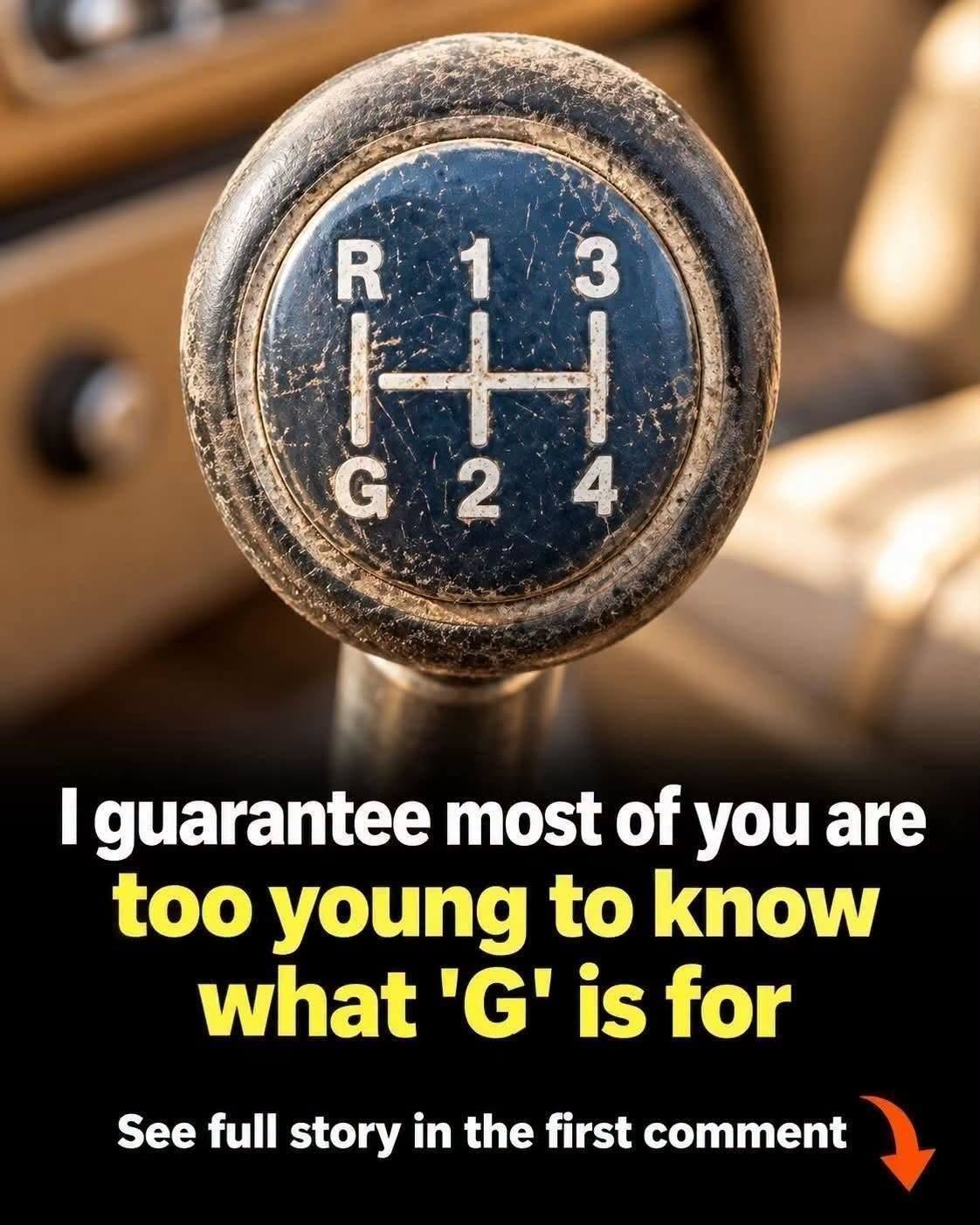
If you’ve ever looked at the gear pattern on an older manual-transmission vehicle and noticed a mysterious “G” where you expected another gear number, you may have wondered what it was supposed to mean.
After all, most manual shifters are easy to understand.
You usually see:
1 — 2 — 3 — 4 — 5
and sometimes R for reverse.
But then, on certain vehicles, there is something different:
G
For drivers unfamiliar with older or specialized manual transmissions, that single letter can be confusing.
Is it another normal driving gear?
Does it stand
for “gear”?
Is it something used for going faster?
Or does it have a completely different purpose?
The answer is surprisingly interesting.
On certain manual transmissions, particularly some older utility, commercial, military, agricultural, and off-road vehicles, “G” can refer to a very low crawler or terrain gear. In German-influenced vehicle terminology, the letter is associated with “Gelände,” meaning “terrain” or “off-road.”
It is not a universal marking, however. The meaning of “G” depends on the specific vehicle and transmission.
And that distinction is important.
The “G” Is Not a Standard
Gear on Every Manual Car
Before going any further, there is one thing every driver should know:
Not every manual transmission uses “G” to mean the same thing.
Modern passenger cars generally use numbered gears, and most drivers will never encounter a “G” position on a conventional road-car transmission.
When the marking does appear, it is usually associated with a particular transmission design rather than a universal automotive standard.
That is why two vehicles can have completely different meanings for unusual letters or markings on their shifters.
The safest approach
is always to check the vehicle’s owner’s manual.
But when “G” is being used in the historical or off-road transmission context, it often points to an unusually low-speed, high-torque gear.
And that is where the story gets interesting.
What Is a Crawler Gear?
A crawler gear is essentially a very low gear designed to let a vehicle move extremely slowly while producing substantial torque at the wheels.
This is completely different from a normal first gear.
Imagine trying to move a heavy vehicle up a steep dirt slope.
The engine
may have plenty of power, but the vehicle needs to move slowly and maintain control.
A conventional first gear may still be too “tall” for the job.
A crawler gear solves the problem by providing a much lower gear ratio.
The engine can rotate at a useful speed while the wheels turn much more slowly.
The result is:
Slow movement
High torque multiplication
Better control
Less need to abuse the clutch
That combination can be extremely useful off-road or when moving heavy loads.
Why Would a Vehicle Need a Gear
That Low?
Think about situations where speed is actually the enemy.
If a vehicle is climbing over rocks, moving through mud, pulling something heavy, maneuvering on a steep grade, or working at very low speed, the driver may not want the vehicle to accelerate quickly.
They want the opposite.
They want control.
A low crawler gear allows the vehicle to move slowly while maintaining strong pulling force at the wheels.
That can make it much easier to control the vehicle in difficult terrain.
Instead of constantly slipping the clutch to
slowly and deliberately.
Why Low Gears Increase Torque at the Wheels
To understand the usefulness of a crawler gear, it helps to think about gear ratios.
Suppose an engine produces a certain amount of torque.
The transmission can multiply that torque before it reaches the wheels.
A very low gear ratio provides more torque multiplication than a higher gear ratio.
That is why a vehicle can climb a steep hill more easily in first gear than in fifth gear.
A crawler gear pushes this principle further.
Instead of maximizing road
speed, the transmission is prioritizing:
Mechanical advantage.
That makes the gear especially useful when the vehicle encounters resistance.
Heavy loads.
Steep slopes.
Mud.
Loose gravel.
Rocks.
Construction sites.
Trailers.
Off-road obstacles.
In these situations, raw wheel speed is often far less important than controlled torque.
Why Off-Road Drivers Care About Control
Off-road driving is not simply about having a powerful engine.
A high-horsepower vehicle can still struggle if the gearing is inappropriate.
When driving over uneven terrain, the driver may need to move at walking pace.
Too much speed can
make the vehicle difficult to control.
It can also cause the wheels to spin, especially on loose surfaces.
A crawler gear can help the driver maintain a very low speed while keeping the engine within a useful operating range.
Instead of constantly manipulating the clutch, the driver can use the transmission’s low gearing to their advantage.
This is one reason specialized vehicles can have transmission systems that look strange compared with ordinary cars.
They were designed around very different priorities.
The Role of the Clutch
A crawler gear can also
reduce the temptation to rely heavily on clutch slipping during difficult maneuvers.
Clutch slipping can generate substantial heat.
Repeatedly holding the vehicle at a very low speed by partially engaging the clutch can accelerate clutch wear.
A suitably low gear can allow the driver to maintain slow movement while keeping the clutch more fully engaged.
That can be especially useful when the vehicle is working under heavy load.
That’s why older machinery can sometimes have gear patterns that look completely unfamiliar to someone accustomed to modern cars.
The unusual markings
reflect the vehicle’s intended job.
The “G” Can Tell You Something About the Vehicle
One fascinating thing about unusual transmission markings is that they can reveal the design philosophy of the vehicle itself.
If a manual shifter has a special low gear, that suggests the engineers expected the vehicle to operate in conditions where:
Torque matters more than speed.
Control matters more than acceleration.
Durability matters more than convenience.
Low-speed maneuvering is part of the vehicle’s job.
That is very different from a small family hatchback designed primarily for city
streets and highways.
A mysterious letter on the shifter may therefore be a small clue about the entire purpose of the vehicle.
Why Drivers Who Learn About It Are Often Surprised
For someone who has only driven conventional manual cars, the concept can feel strange.
Most drivers learn a simple sequence:
Start in first.
Shift to second.
Then third.
Then fourth.
And continue upward as speed increases.
The assumption is that every lower gear exists primarily to get the car moving or accelerate.
A crawler gear challenges that assumption.
It
is not necessarily there because the vehicle needs another step before first gear.
It exists because certain situations require even more mechanical advantage than ordinary first gear provides.
Once you understand that, the “G” suddenly makes sense.
It is not an extra highway gear.
It is almost the opposite.
A Simple Example
Imagine you’re driving a heavily loaded vehicle up a steep, uneven trail.
In a standard first gear, the vehicle may still move too quickly.
If you lift off the accelerator, the vehicle may slow but then threaten to
stall.
If you use the clutch to control speed, you generate heat and wear.
With a crawler gear, you can select an extremely low ratio.
Now the wheels turn slowly while the engine continues operating at an appropriate speed.
The vehicle creeps forward.
There is less need to constantly slip the clutch.
You can concentrate more on steering, traction, and terrain.
That’s the fundamental idea.
The vehicle is trading speed for control.
Is Every “G” the Same?
No.
This is an important caution.
A letter printed on a gear selector