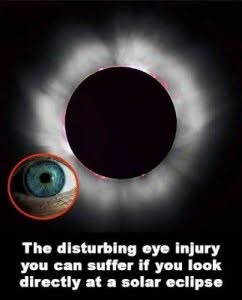
A solar eclipse is one of nature’s most spectacular sights. As the Moon passes between Earth and the Sun, daylight can briefly fade and the sky can take on an eerie appearance. But staring directly at the Sun during an eclipse can cause a serious eye injury—and the damage may occur before you realize anything is wrong.
The condition is commonly known as solar retinopathy, an injury to the retina caused by intense sunlight entering the eye.
Why an Eclipse Can Be Dangerous
The Sun remains extremely bright during most phases of a solar eclipse. Even when much of the Sun is covered, the remaining visible portion can produce enough concentrated light to damage sensitive retinal tissue.
The retina is the light-sensitive layer at the back of the eye. Unlike the skin, it does not produce the same immediate pain response when exposed to damaging sunlight. That means a person can stare at the Sun without feeling an obvious warning while injury is occurring.
The danger is particularly deceptive because an eclipse can make people feel as though the Sun is safer to look at than it normally is.
Solar retinopathy occurs when intense light damages cells in the retina, particularly in an area called the macula that is responsible for sharp central vision.
Symptoms may not appear immediately. Within hours or sometimes after a delay, a person may notice:
- A blurry or distorted area in the center of their vision
- A dark or blind spot
- Difficulty reading or recognizing details
- Changes in color perception
- Increased sensitivity to light
- Distorted straight lines
In some cases, the injury can improve gradually. In others, retinal damage may be permanent.